
EN
- ES
- EN
Start of main content

Humanities Conference Thursday, 24 March 2022, 19:00 hours Madrid
It belongs to cycle: The planet in eruption. Geography lessons from the Cumbre Vieja volcano on La Palma.
Venue: Fundación Ramón Areces - salón de actos. Calle Vitruvio, 5. 28006. Madrid.
Free admission. Necessary previous online registration. Limited capacity.
Organized by:
Fundación Ramón Areces and Sociedad Geográfica Española
Coordinator/s:
Lola EscuderoSecretaria General de la Sociedad Geográfica Española
When the landscape is a volcano. What the earth owes to volcanoes: geography, literature and art under the volcano
The eruption is not an anomalous event in our Mediterranean and Atlantic civilization. From the oldest songs and myths it is present in it and its catastrophes are told even today with dread. Together with the classical world, the biblical background of our culture also expresses the allegory of the eruption at the very birth of the divine norm. And the flames of the deep earth have later sheltered, in masterpieces, a religious geography of death and guilt.
Later, but already for centuries, exploration and science have intuited or described an interior of the planet with networks of channels and chambers of fire whose ends would appear in the igneous mouths of the volcanoes. In recent times of experience and reason, the explanation of its dynamisms has been sought, its maps have been drawn with the description of its places, its modalities have been classified and its disasters have been tried to be alleviated by knowing its behavior. Art has also created a parallel image of the strong beauty of the volcano as a specific branch of the landscape.
In its own territory, the Iberian Peninsula also shows dead or dormant volcanic landscapes. But it is in the Canary Islands where the eruptive manifestations have built all of its reliefs and where they are still active. The recent eruption of La Palma, after fifty years of volcanic calm on the island, is but the latest episode, for the time being, in the active physical construction of the archipelago.
18:30 h.
Attendees check-in
19:00 h.
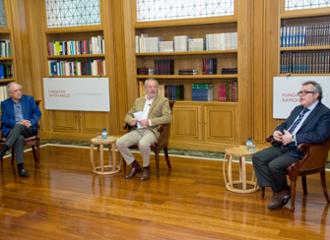
Lola Escudero
Secretaria General de la Sociedad Geográfica Española.
19:10 h.
Eduardo Martínez de Pisón
Catedrático emérito de Geografía Física de la UAM, experto en paisajes volcánicos. Director del “Instituto del Paisaje” de la Fundación Duques de Soria.

Geographer. Emeritus Professor of Physical Geography at the Autonomous University of Madrid since 2007 and one of the great expert geographers on volcanoes, a figure of reference in Spain for the conservation of the natural environment. He has closely followed the eruption of Cumbre Vieja and in 1971 he was present as an expert in the eruption of Teneguía, also on La Palma. His works have focused on the study of natural landscapes, mountain range geomorphology, volcanology, geographical thought and environmental geography, with more than 700 publications, of which more than 60 in the form of books, on these topics. He has been a member of the Spanish UNESCO MaB Committee and has participated as an advisor for television documentaries in the most extreme corners of the planet. He has been a member of the 'Scientific Committee of National Parks' and is a member of the boards of trustees of the Ordesa y Monte Perdido National Park, Sierra de Guadarrama National Park and Teide National Park.
Since 1999 he has been Director of the "Landscape Institute" of the Duques de Soria Foundation. He has received, among other recognitions, the National Prize for the Environment, the Medal of the Community of Madrid and the Commendation for Environmental Merit. For his contribution to the Spanish expedition to the North Pole, he received the Medal of Military Merit.
 Activities related
 Projects related
 News related
 Publications related
Conference Los nuevos viajes al fondo de la Tierra Madrid, Tuesday, 3 October 2023, 19:00 hours
Conference Las zonas polares, el gran reto de la aventura Madrid, Tuesday, 17 October 2023, 19:00 hours
Conference Exploradores “al filo de lo imposible” Madrid, Monday, 23 October 2023, 19:00 hours
“Las medidas tomadas contra la pandemia han sido las mismas que las de hace siglos”
Published on 06/16/2020


End of main content
